Window material comparison
Aluminium vs Timber Windows in Malta: Which Is Better?
If you're replacing windows in Malta, aluminium, timber and uPVC are all options. This guide focuses on the differences between aluminium and timber.
For many homeowners, the answer depends on three things:
- Comfort
- Planning requirements
- Long-term value
Technical specifications
These are the standard specification options used as the starting point for a Heritage Apertures estimate. The final recommendation depends on the complete opening, property and project requirements.
- Frame profile and glazing basis
- 68 mm wood frame + 32 mm triple glazing is the standard, lower-cost basis. 78 mm wood frame + 42 mm triple glazing is the higher-cost upgrade for stronger soundproofing and insulation.
- Compatibility
- A 68 mm wood frame supports glazing up to 32 mm, including 32 mm double or triple glazing. A 78 mm wood frame supports glazing up to 42 mm; 42 mm triple glazing requires 78 mm.
- Timber options (wood species)
- Oak or Mahogany.
- Glazing and glass finish
- Double or Triple glazing with Clear or Frosted glass.
- Performance options
- Swisspacer thermal edging, plus Acoustic, Security or no performance glass.
- Default estimate basis
- Triple glazing with sun protection and sound/acoustic protection. If no frame profile is chosen, the estimate basis is 68 mm wood frame + 32 mm triple glazing. These are defaults, not customer-confirmed selections.
- Default opening basis
- Inward-opening tilt and turn. Units wider than about 600 mm are usually split left and right; viewed from inside, the right sash is usually the primary opener.
Aluminium Windows
Aluminium windows have been widely installed in Malta for decades.
Advantages
- Lower initial cost
- Minimal maintenance
- Modern appearance
Disadvantages
- Poor insulation in older single-glazed systems
- Higher heat transfer
- More outside noise
- Condensation can be more noticeable
- Usually unsuitable for many UCA and heritage properties
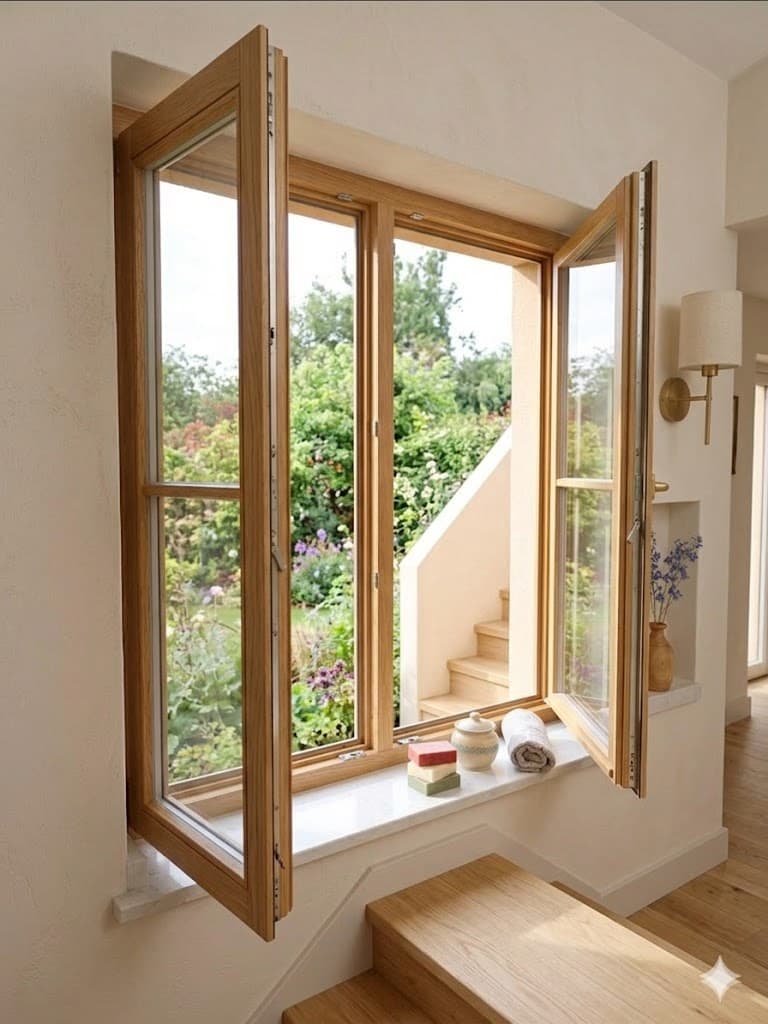
Modern Timber Windows
Today's engineered timber windows are very different from traditional solid timber windows.
Modern systems combine engineered timber frames with high-performance double or triple glazing and premium European hardware, preserving the character of real wood while improving stability.
Advantages
- Excellent thermal insulation
- Significantly reduced outside noise
- Traditional appearance
- Suitable for many UCA properties
- Repairable and refinishable
- Long service life
Comparison
| Feature | Older Aluminium | Modern Timber |
|---|---|---|
| Lower purchase price? | Yes | No |
| High thermal insulation? | No | Yes |
| High noise reduction? | No | Yes |
| Lower condensation risk? | No | Yes |
| Suitable for many UCA properties? | No | Yes |
| Repairable and refinishable? | No | Yes |
| Traditional appearance? | No | Yes |
Is Timber More Expensive?
Usually, yes.
However, homeowners are typically investing in:
What the investment can provide
- Better comfort
- Reduced outside noise
- Improved energy efficiency
- Longer product life
- Better appearance
- Compliance with planning requirements
Rather than simply buying another window.
Which Is Right For You?
If your priority is the lowest purchase price, aluminium may still be suitable.
If your priority is comfort, reduced noise, traditional appearance and long-term value, engineered timber windows are often the better investment.
Every property is different.
The quickest way to understand the likely specification and budget is to request a personalised estimate based on your property and requirements.
Aluminium vs Timber FAQs
Direct answers to frequent homeowner questions when comparing aluminium and timber window replacements:
Why do older aluminium windows feel so cold and collect condensation?
Aluminium is a highly conductive metal. Older aluminium frames lack a thermal break (polyamide insulation separating interior and exterior metal). This causes the frame to become freezing in winter, acting as a cold bridge that draws moisture from the room air and creates heavy condensation.
How do timber windows perform in coastal, salt-air environments compared to aluminium?
Salt air in coastal environments can cause pitting, oxidation, and electrochemical corrosion on aluminium finishes and hardware fasteners over time. High-grade engineered timber treated with microporous protective coatings is naturally inert to salt spray, while our marine-grade stainless steel hardware ensures long-term operational durability.
Can timber windows match slim sightlines while meeting heritage requirements?
Yes. Our bespoke timber profiles are engineered with narrow, elegant sightlines that authentically recreate historic profiles and traditional Maltese balcony/sash designs while accommodating high-performance double or triple glazing.
Do timber windows insulate against heat better than thermally broken aluminium?
Wood has a natural cellular structure with very low thermal conductivity (~0.13 W/mK), making it an inherent natural insulator. Even high-end thermally broken aluminium relies on synthetic plastic inserts to approach the natural thermal resistance of a solid engineered timber frame.